WHY ARE UAV WINGS DESIGNED THIS WAY?
Wing Design for Speed, Altitude & Endurance
When you look at a UAV from a distance, one of the first things you notice is its wings. Some are long and thin, some are short and wide, and some platforms have almost no conventional tail at all.
Why? The answer is not aesthetics. It is mission requirements.
A UAV's speed, endurance, operating altitude, payload capacity and even how easily it can be detected by radar are largely determined by its wing design.
This article examines modern UAV wing geometries, why they differ and which design choices suit different missions.
What Is the Wing's Main Job?
The wing does not move the UAV forward. The engine or propeller produces thrust, while the wing uses the airflow created by forward motion to produce lift.
NASA describes the four fundamental physical forces that make flight possible:
- Lift: The force produced by the wings that lifts the aircraft upward.
- Weight: The effect of gravity pulling the aircraft downward.
- Thrust: The force produced by the engine that pushes the aircraft forward.
- Drag: The retarding effect of air resistance pulling the aircraft backward.
For steady level flight, these forces must remain in balance: when lift equals weight and thrust equals drag, the UAV maintains its altitude and speed while continuing to fly.
Why Are Some UAV Wings So Long?
Long wings generally have a high aspect ratio, roughly the ratio of wingspan to average chord. As this ratio increases, the harmful wingtip vortices known as induced drag decrease. With less drag, fuel consumption falls and endurance can increase significantly.
This is why long wings are standard on platforms designed for long-duration reconnaissance, surveillance and intelligence missions:
- Bayraktar TB2, TUSAŞ ANKA and AKSUNGUR: Turkish MALE UAVs known for their operational success and long-duration missions.
- RQ-4 Global Hawk: A global surveillance platform with a wingspan approaching 40 metres, designed to scan wide areas from high altitude.
- Airbus Zephyr: One of the clearest examples of this design philosophy taken to its limits. Despite a wingspan of approximately 25 metres, this solar-powered UAV weighs only about 75 kg and achieved a 64-day continuous flight record through its ultra-high aspect ratio.
Are Long Wings Always Better?
No. The aerodynamic advantages of long wings also bring serious engineering challenges. As the wing becomes longer, structural loads at the wing root increase and the wing can experience excessive flexing. This may require a heavier fuselage, more complex manufacturing techniques and careful hangar planning. Long-wing platforms can also have limited instantaneous maneuverability.
Critical optimization: Designers do not simply choose the “longest” wing. They balance the required endurance, payload capacity, target flight speed, structural strength, manufacturing cost and logistical or operational constraints such as runway length and hangar space.
Why Are Straight Wings Still Used?
Straight wings provide high lift and strong aerodynamic efficiency at low and medium flight speeds. Compared with complex and costly geometries, they are easier to manufacture and can be structurally lighter. This is why they remain one of the strongest solutions for continuous reconnaissance, border surveillance, maritime patrol and intelligence (ISR) missions.
Turkey's leading platforms provide clear examples of this efficiency:
- Bayraktar TB2: Its straight and efficient wing design supports flights exceeding 27 hours.
- TUSAŞ ANKA: It can remain airborne for more than 30 hours, including in demanding weather conditions.
- AKSUNGUR: It combines the same straight-wing philosophy with twin engines to achieve mission endurance of up to 50 hours.
These achievements show that wing shape alone is not the deciding factor; wing design must be developed as part of a fully integrated system with the engine, lightweight fuselage and fuel capacity.
Why Are Swept Wings Used?
As speed increases, compressibility effects and wave drag caused by shock waves become more important. Swept-wing geometry is designed to manage these effects, especially in flight approaching transonic speeds.
- Reduces wave drag: It helps minimize the resistance that appears near the speed of sound.
- Enables higher cruise speed: It allows the UAV to reach the target area more quickly.
- Works well with jet engines: It helps convert the thrust of high-power jet engines into efficient forward flight.
For this reason, swept wings are common on modern fighter aircraft, jet-powered UAVs and high-speed UCAVs carrying substantial mission payloads. Bayraktar KIZILELMA is one of Türkiye's clearest examples of this design approach.
Why Use a Flying-Wing Design?
A flying wing is an innovative layout with no conventional tail and no clear separation between the fuselage and wings; the wing also performs the role of the fuselage. This design is developed to combine generous internal volume, aerodynamic efficiency and low radar observability goals.
On platforms such as TUSAŞ ANKA-3, this approach combines low observability with high-speed deep-strike capability designed to penetrate behind an adversary's lines.
It does not guarantee invisibility: Flying-wing geometry can make a major contribution to low radar observability, but the final result depends on precise body angles, composite materials, concealed air intakes, exhaust heat management and the platform's overall design.
Do Winglets Really Help?
Winglets are the upward-curved surfaces seen at the wingtips. They can reduce the vortices created when high-pressure air from below the wing spills over the upper surface, lowering the resulting induced drag. This can improve fuel efficiency and range.
However, winglets also add weight and structural loads. Their benefit depends on the complete wing, flight speed and mission profile. Therefore, not every UAV needs winglets and the same advantage should not be expected on every platform.
Does the Wing's Role Change on VTOL UAVs?
No; only the division of labor between flight phases changes. In hybrid systems, rotors act like a helicopter's rotors during vertical takeoff and landing, generating lift. Once the UAV accelerates into horizontal flight, the fixed wings capture the airflow and become the main source of lift again.
Bayraktar KALKAN DİHA is an example of a hybrid platform that combines runway-independent takeoff from bases or ships with the long range and fuel efficiency provided by fixed wings during cruise.
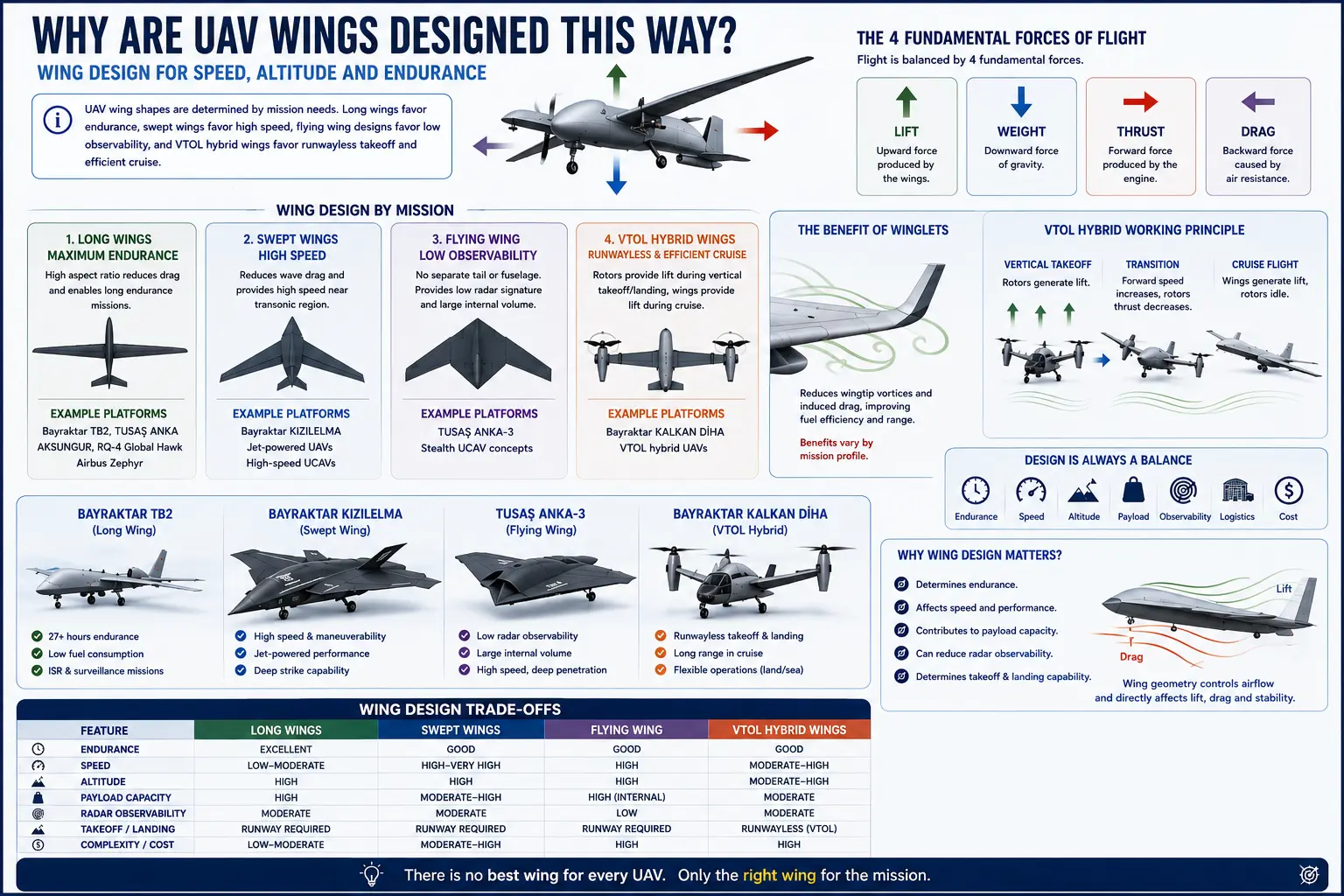
A UAV wing is more than a part that keeps the aircraft airborne. Endurance, speed, altitude, payload, radar observability and takeoff method all influence its design.
There is no single best wing; there is a wing suited to the mission. The TB2's long, slender wing and KIZILELMA's swept jet wing look very different, but both are solutions selected for their mission profiles.