How Do UAV Engines Work? Power and Thrust for the Mission
Which missions favor piston, turboprop, turbofan and electric propulsion systems?
What makes a UAV move forward and therefore stay supported in the air by its wings? Often simplified as “engine thrust,” the answer actually involves two different forces: the engine provides power to a propeller or fan through a shaft, while the propeller or jet exhaust accelerates air backward to create net thrust. As the UAV moves forward, air flowing over its wings produces lift. These propulsion and thrust mechanisms can be grouped into four main categories according to the mission.
For a UAV performing anything from surveillance to strategic strike missions, speed, altitude, endurance and payload capacity are directly related to the characteristics of its propulsion system. Engineering therefore has no single “best engine”; it has the most suitable engine for a specific mission.
Piston Engines: Cost-Effective Propulsion
Piston engines use a working principle similar to automobile engines, optimized for aviation standards. The linear movement of pistons inside cylinders is converted into rotary motion by a crankshaft. This motion is transferred directly or through a reduction gearbox to the propeller. The propeller accelerates air backward and gives the UAV forward thrust in accordance with Newton’s third law.
Because of their relatively low fuel consumption, these engines are used in MALE-class reconnaissance and surveillance UAVs that must remain airborne for long periods at medium altitude. They are relatively inexpensive to produce and straightforward to maintain. However, their many moving parts create vibration, and their power-to-weight ratio is generally lower than that of turbine engines. They are also often supported by turbocharging to reduce power loss at high altitude.
Baykar developed the domestic TM100 engine for standard Bayraktar TB2 platforms. The TB2T-AI model is a separate development that uses a more powerful turbo engine and advanced artificial-intelligence systems.
Turboprop Engines: Long Endurance
Turboprop engines use a gas-turbine, or jet-engine, architecture, but convert the kinetic energy of exhaust gases into shaft power through turbine blades. This high-speed shaft power is transferred to the propeller through a reduction gearbox. Approximately 85–90% of total thrust comes from the propeller, with the remaining portion coming from the jet exhaust flow.
They are highly fuel-efficient at medium-to-high altitude and subsonic speeds. As propeller-tip speed approaches the speed of sound, aerodynamic resistance—especially wave drag—increases and propeller efficiency falls. Turboprops therefore favor heavy weapon or payload carriage and long endurance at high altitude rather than high speed.
Platform examples:
- MQ-9 Reaper: A global reference platform powered by a Honeywell TPE331-10GD turboprop producing approximately 900 shp.
- Bayraktar AKINCI: A heavy UCAV using twin Ivchenko-Progress AI-450T engines and more powerful alternatives for high payload capacity.
The TEI-PD170 used on these platforms is not a turboprop, despite a common misconception; it is a 172 hp, twin-stage turbocharged diesel piston engine. According to TEI data, it can use JP-8 and JET-A1 jet fuels as well as EN 590 diesel fuel, and gives the platform a maximum altitude capability of 45,000 ft.
Turbofan Engines: High Altitude and Speed
In turbofan engines, part of the air accelerated by the large front fan flows through an outer bypass duct without entering the engine core. The remaining air is compressed in the core, mixed with fuel and burned to create a high-speed jet exhaust. Net thrust comes from the combination of bypass air and hot exhaust flow.
When combined with an appropriate airframe, turbofans provide a unique advantage in HALE-class (High Altitude–Long Endurance) strategic reconnaissance missions and next-generation unmanned combat aircraft (UCAVs). The extreme altitude performance of the RQ-4 Global Hawk, for example, is the combined result of its engine, ultra-light composite fuselage and glider-like aerodynamic wing design. Turbofans are more complex and costly than turboprops and less fuel-efficient at low altitude, but they can give UAVs high-subsonic and supersonic speed capability.
Platform examples:
- RQ-4 Global Hawk: A HALE platform optimized for strategic reconnaissance and powered by a Rolls-Royce AE 3007H high-bypass turbofan.
- Kratos XQ-58A Valkyrie: A technology demonstrator using a turbofan producing approximately 2,000 lbf, designed around high speed, low observability and the loyal-wingman concept.
Important Turkish UAVs Using Turbofan Engines
- TUSAŞ ANKA-3: A turbofan-powered unmanned combat aircraft with a tailless flying-wing configuration designed to reduce radar visibility. The platform completed its first flight in December 2023, combining this airframe design with high-speed and low-observability objectives.
- Baykar Bayraktar KIZILELMA: This unmanned combat aircraft platform has been associated with Ivchenko-Progress AI-25TLT and AI-322F turbofan engines in its prototypes and early flight tests.
TEI-TF6000 is one of Türkiye’s major national turbofan-engine development projects. The engine was first run in March 2024 and is intended to power unmanned combat aircraft such as ANKA-3 and KIZILELMA.
Electric Motors: Silence and Instant Torque
Electric UAVs receive power mainly from lithium-based (Li-Po, Li-Ion) batteries or hydrogen fuel cells. An electronic speed controller (ESC) regulates the direct current from the battery and sends it to the phases of a brushless DC (BLDC) motor, which turns the propeller.
Electric motors are mechanically simple, produce instant torque, generate little vibration and leave a much lower acoustic signature than internal-combustion engines. They are therefore common in miniature and micro reconnaissance UAVs, multirotor drones and vertical-takeoff-and-landing (VTOL) tactical platforms. They are not completely silent: even when the motor itself is quiet, aerodynamic noise from the propeller remains. Their main limitation is the low system-level energy density of batteries. Once cooling, cabling, ESC and structural weight are included, long endurance and heavy-payload missions become difficult. Thermal runaway and fire caused by high discharge rates or physical damage are also critical safety concerns.
Platform examples:
- AeroVironment RQ-11 Raven: A widely used hand-launched miniature reconnaissance UAV powered entirely by batteries and a BLDC motor.
- Bayraktar KALKAN DİHA: Uses a hybrid power architecture, relying on electric motors for vertical takeoff and landing and switching to a gasoline piston engine during horizontal cruise to extend range.
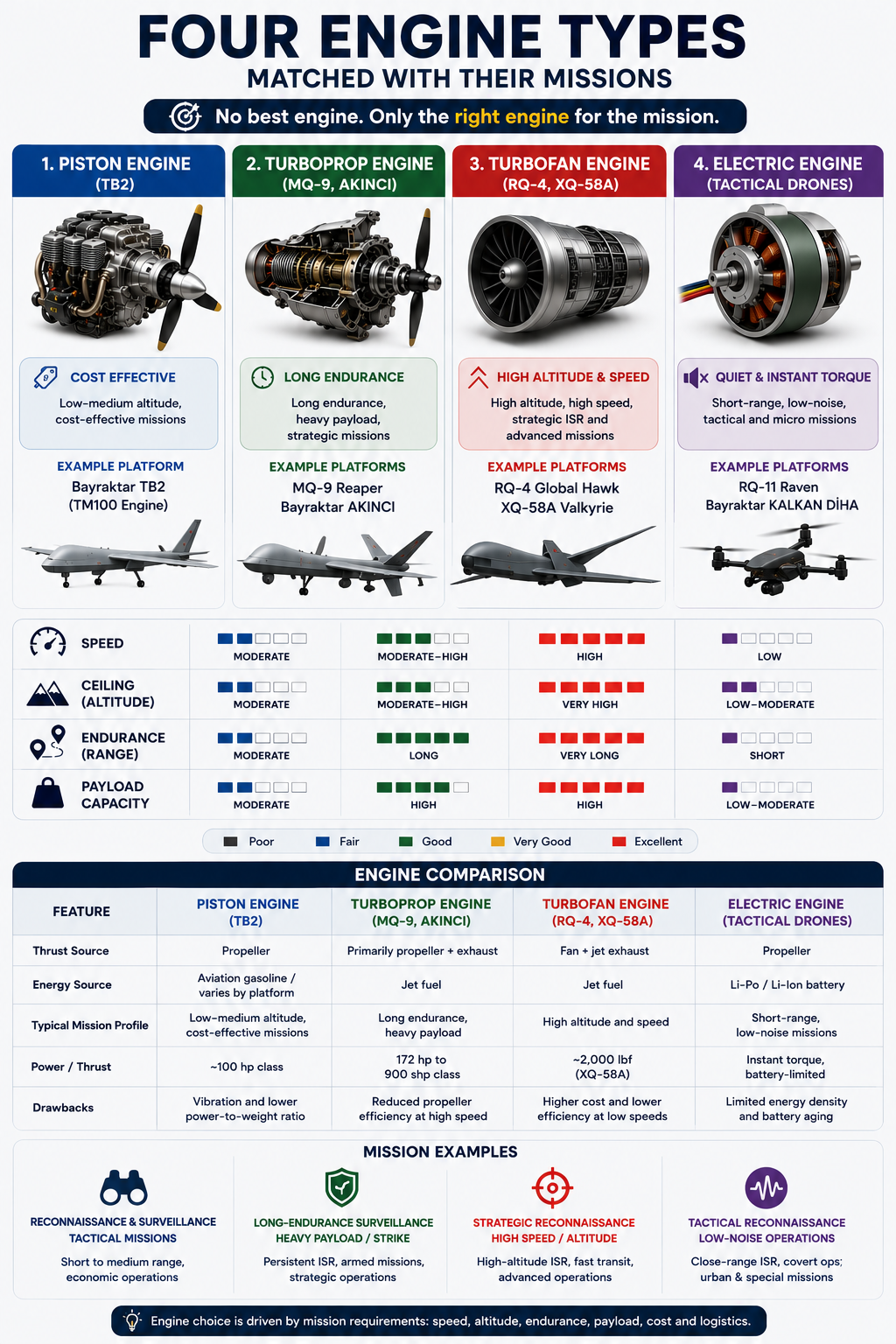
Motor Selection Factors
- Speed and altitude: Turbofans favor high-speed and high-altitude missions; turboprops or piston engines suit subsonic, long-duration operations.
- Endurance: Efficient turboprops, fuel cells and hybrid architectures can offer advantages on long missions.
- Logistics: Engines compatible with JP-8, JET-A1 or suitable diesel fuels can simplify military supply chains.
- Stealth: Electric systems can help when low noise and a reduced heat signature matter, although they are not mandatory for every tactical mission.
- Payload: Heavy sensors or weapons require high shaft power or high jet thrust.
There is no single engine that performs every UAV mission equally well. The Bayraktar TB2 uses a piston engine for cost and tactical flexibility; the MQ-9 Reaper uses a turboprop for endurance and payload balance; the AKINCI uses twin turboprops for high payload capacity; and the RQ-4 Global Hawk uses a turbofan for strategic high-altitude surveillance.
Whatever the sophistication of the airframe, wings and sensors, the propulsion system defines much of the platform’s mission identity. The right engine is not necessarily the most powerful one; it is the one that best matches the mission’s speed, altitude, range, payload, cost and logistics requirements.