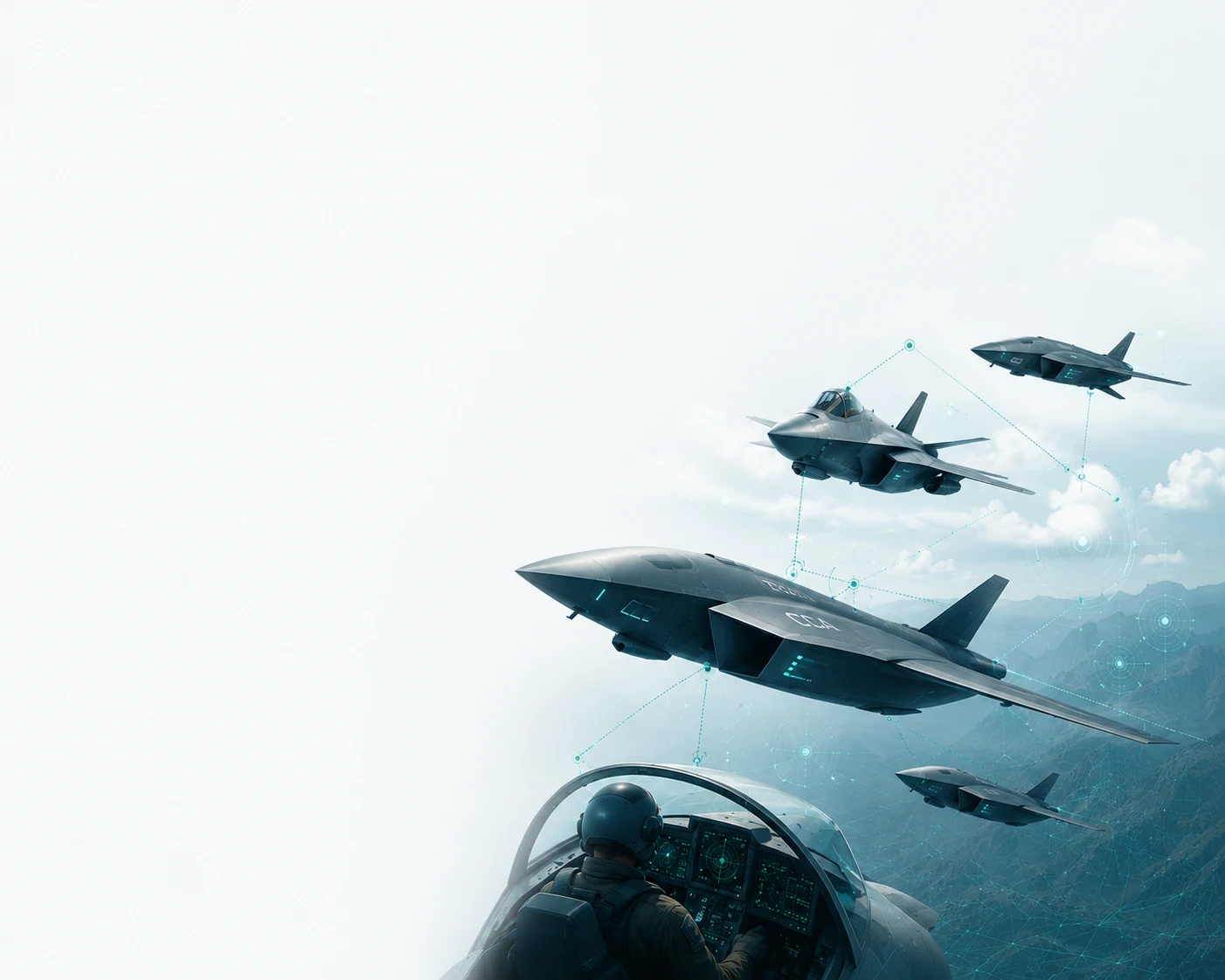
1Foundational Concepts: Defining Loyal Wingman, CCA, MUM-T, and Autonomy
Before delving into the comparative analysis of the MQ-28 Ghost Bat, YFQ-42A, YFQ-44A, X-BAT, and VENOM programs, it is imperative to establish a clear and consistent conceptual foundation. The terminology surrounding next-generation unmanned systems is often used interchangeably in public discourse, yet each term carries distinct nuances that are critical for understanding the operational concepts and architectural philosophies of the platforms under review. This section clarifies the definitions of four core concepts—Loyal Wingman, Collaborative Combat Aircraft (CCA), Manned-Unmanned Teaming (MUM-T), and Autonomy—as they are applied in the provided source materials. These definitions will serve as the analytical lens through which the subsequent sections examine task allocation and control-sharing architectures.
The term Loyal Wingman describes the operational role or mission concept of an unmanned aircraft designed to operate in close proximity and coordination with a crewed military aircraft . It is not a formal designation but rather a descriptive phrase for a capability. The core idea is to create a "smart human-machine team" where the unmanned system acts as a supporting asset, enhancing the lethality, survivability, and situational awareness of the manned platform . The duties of a loyal wingman drone can include performing surveillance and reconnaissance (ISR), electronic warfare, decoy operations, suppression of enemy air defenses (SEAD), and even direct strike missions .
The Royal Australian Air Force (RAAF) has explicitly noted that adopting a loyal wingman concept allows smaller forces to break from traditional boutique force mindsets and instead embrace the concept of mass airpower . The MQ-28 Ghost Bat is frequently described using this terminology, as it is designed to support manned aircraft through its surveillance and defensive capabilities . Collaborative Combat Aircraft (CCA) is the formal programmatic name for the U.S. Air Force's initiative to develop a new class of uncrewed combat aircraft .
The CCA program is explicitly structured to develop autonomous unmanned aircraft that cooperate in the "loyal wingman" role with fifth- and sixth-generation combat aircraft like the F-35 and the future NGAD . Therefore, the YFQ-42A and YFQ-44A are specific prototypes developed under the CCA umbrella, representing tangible implementations of this broader strategic concept . The USAF envisions CCAs as large, jet-powered, semi-autonomous Group 5 unmanned aircraft that will act as force multipliers, operating alongside crewed fighters to enhance sensor and weapons capacity . The program aims to achieve "affordable mass," creating a high-low mix that can project power both inside and outside adversary threat envelopes .
The development of CCAs represents one of the Air Force's most ambitious acquisition programs in generations, reflecting a fundamental shift in air combat doctrine . Manned-Unmanned Teaming (MUM-T) is the operational doctrine that defines the method of interaction and collaboration between human-piloted platforms and unmanned systems . It refers to a continuous flight operation where manned and unmanned aircraft fly closely together, sharing data and operating as a single, interconnected network . This is a significant evolution from traditional UAV operations where drones are remotely controlled throughout all phases of flight .
MUM-T is described as transitioning from a conceptual ambition to an operational doctrine, reshaping how airpower is designed and employed . All the programs analyzed in this report—the MQ-28, YFQ-42A, YFQ-44A, X-BAT, and VENOM—are fundamentally built around MUM-T principles . The goal is to leverage the unique capabilities of both humans and machines, with the human providing strategic oversight and ethical judgment, while the autonomous system handles complex tactical execution, thereby optimizing team performance and reducing pilot workload . Finally, Autonomy is the central technical and philosophical element governing the relationship between human and machine.
Rather than applying a rigid Level 1-4 taxonomy, this report uses levels of automation as a flexible conceptual framework. The sources highlight several distinct types of autonomy relevant to these programs. Flight Autonomy is the baseline capability, encompassing basic functions like takeoff, landing, and following pre-programmed routes. This is a feature of nearly all modern UAVs.
More critically, Mission Autonomy is the defining characteristic of the new generation of loyal wingmen. This is an AI-powered capability that enables an aircraft to execute complex, dynamic tasks based on high-level goals provided by a human operator . For example, an operator might give the command "establish a defensive counter-air orbit," and the autonomous system would determine the precise maneuvers, manage sensors, and maintain formation without further input . This is the "AI pilot" that figures out the "how" to achieve the human-determined "what" .
The prevailing doctrinal approach across all the analyzed platforms is Human-on-the-Loop (HOTL). This means a human operator maintains continuous awareness of the system's actions and retains the authority to intervene or override the AI at any time . The VENOM program, for instance, is explicitly designed with a HOTL requirement, where a human pilot is always present in the cockpit to oversee the AI's actions . This model is considered a crucial step toward building trust in combat autonomy and stands in contrast to the more restrictive "human-in-the-loop" (requiring constant input) and the more ethically contentious "human-out-of-the-loop" (fully autonomous lethal action) paradigms .
The current market for loyal wingman platforms is dominated by the human-on-loop segment, accounting for 44% of the market .
2The MQ-28 Ghost Bat: An Integrated, Low-Workload Operator Model
The Boeing MQ-28 Ghost Bat program, a collaborative effort between Boeing and the Royal Australian Air Force (RAAF), exemplifies a mature and highly integrated approach to manned-unmanned teaming . Its control architecture is meticulously designed to minimize the cognitive workload on the human operator while maximizing the effectiveness of the unmanned system as a lethal and survivable extension of the manned fleet. This model prioritizes seamless interoperability with existing airframes, treating the Ghost Bat not as an independent entity but as a trusted agent that executes high-level commands with tactical independence. The program's success is measured by its ability to be directed by a higher-fidelity sensor platform to perform dangerous tasks from a safer distance, effectively acting as an organic weapon station .
In terms of task allocation, the human operator's role is primarily strategic and supervisory. The system is architected around a principle of goal-oriented delegation, where the human determines the objective ("what") and the trigger ("when"), while the aircraft autonomously determines the optimal execution path ("how") . This is vividly illustrated in a landmark live-fire engagement conducted by Boeing and the RAAF, where the MQ-28 was tasked with destroying a fighter-class target . According to reports, the Ghost Bat received only four high-level commands during the entire mission: initiate take-off, establish a defensive counter-air orbit, engage the target, and return .
This demonstrates a profound level of delegated autonomy. The human commander did not need to micromanage the aircraft's every maneuver; instead, they provided the mission intent, and the Ghost Bat's onboard autonomy handled the intricate details of navigation, sensor management, and weapon employment . This delegation is a core tenet of modern human-autonomy teaming, allowing pilots to focus on broader mission objectives rather than the granular control of individual assets . The control sharing and data flow architecture of the MQ-28 is engineered for deep integration into the battlespace network, typically centered around a manned command-and-control platform.
In the December 2025 test, the Ghost Bat operated in concert with a RAAF E-7A Wedgetail and an F/A-18F Super Hornet . The E-7A, a large airborne early warning and control (AEW&C) aircraft, served as the primary sensor and targeting node, providing the initial cue for the threat . The MQ-28 then acted as the shooter, carrying and firing an AIM-120 Advanced Medium-Range Air-to-Air Missile (AMRAAM) to destroy the target . This configuration establishes a clear master-slave relationship, where the manned aircraft (the E-7A) provides the "brain" with superior situational awareness and processing power, and the Ghost Bat serves as the "muscle," executing the lethal action at a lower risk to the high-value manned asset .
The sensor fusion occurs at the manned platform level, which then transmits a final, authoritative targeting solution to the Ghost Bat to authorize the engagement . This makes the Ghost Bat an effective tool for extending the reach and survivability of the entire air combat element . The aircraft is designed to complement the find, fix, track, and target elements of air combat with autonomous behaviors that reduce the burden on the manned fleet . Regarding contingency planning for communication loss, the MQ-28's architecture is predicated on the concept of "trusted autonomy" .
While specific procedures are not detailed in the provided sources, the emphasis on autonomous behaviors implies that the aircraft is programmed to handle such scenarios gracefully . Standard protocols for advanced UAVs involve adapting to link degradation rather than ceasing operations entirely . If the datalink to the E-7A or the ground control station is lost or severely degraded, the Ghost Bat would likely continue operating based on its last set of instructions or follow a predetermined fallback plan . This could involve holding its position in the established orbit, initiating a return-to-base procedure, or engaging autonomous contingency behaviors designed to preserve the asset and maintain its posture within the formation until communication is re-established .
The system's ability to think independently and make decisions in contested environments suggests it is equipped to manage itself during periods of intermittent connectivity, ensuring it remains a viable component of the team even under adverse conditions . The overall design philosophy treats the human operator as a high-level mission planner who delegates complex tasks to the Ghost Bat, which in turn manages its own flight and mission execution, creating a symbiotic relationship that enhances the effectiveness of the entire air combat team .
3The YFQ-42A: A Modular Open-Architecture Testbed
The General Atomics Aeronautical Systems (GA-ASI) YFQ-42A prototype is a cornerstone of the U.S. Air Force's (USAF) Collaborative Combat Aircraft (CCA) program, embodying a strategic shift towards modular, open-architecture systems . Unlike some platforms designed as monolithic solutions, the YFQ-42A serves as a critical testbed for validating the USAF's Autonomy Government Reference Architecture (A-GRA), a standardized framework intended to foster competition and rapid innovation in mission autonomy . Its control architecture is therefore defined less by its specific airframe and more by its capacity to seamlessly integrate and operate with third-party autonomy software, making it a versatile platform for exploring different models of human-machine collaboration.
Task allocation and control sharing on the YFQ-42A adhere to the "human-on-the-loop" (HOTL) paradigm, where a human operator maintains supervisory authority over the aircraft's actions . However, the key distinction lies in the sophistication of the autonomy layer with which the human interacts. The YFQ-42A successfully completed a four-hour semi-autonomous flight test using mission autonomy software provided by RTX's Collins Aerospace, known as "Sidekick" . During this test, a human operator on the ground transmitted various high-level commands directly to the aircraft, which were executed with high accuracy by the Sidekick autonomy system .
This demonstrates a sophisticated division of labor: the human determines the overall mission intent and goals, while the AI-powered Sidekick software assumes responsibility for the tactical execution, including complex piloting and mission management tasks . The operator is not engaged in manual flight control but rather in supervising the AI's performance and making strategic decisions. This model allows the human to delegate complex tasks like surveillance or strike missions, freeing them to focus on higher-order command and control functions . The control-sharing and data flow architecture of the YFQ-42A is fundamentally rooted in its open-systems design.
The aircraft is built to be a flexible platform capable of rapid mission reconfiguration for roles such as air-to-air combat, electronic warfare, precision strike, and ISR . This modularity extends to its software stack. The successful integration of Collins' Sidekick autonomy software showcases a critical milestone for the USAF: proving that third-party autonomy solutions can be seamlessly integrated with the YFQ-42A's flight control system and onboard mission systems . This data exchange between the autonomy software and the aircraft's systems ensures precise execution of commands .
The use of standardized interfaces, likely compliant with NATO standards like STANAG 4586, facilitates interoperability with allied platforms and ensures robust, encrypted communication channels for authentication and data transfer . The YFQ-42A is thus not just an air vehicle but a platform for developing a competitive ecosystem of "brains" for future CCAs, where operators can potentially choose from a menu of best-in-class autonomy packages tailored to specific mission needs aviationnews.eu . In the event of communication loss, the YFQ-42A's open-architecture design supports graceful degradation. The provided information indicates that if the datalink is degraded or lost, the drone is designed to continue operating based on its last set of instructions or follow predetermined contingency plans .
The modular nature of its autonomy stack, such as Sidekick, implies the presence of robust failsafe protocols. When communication is lost, the system adapts by engaging autonomous fallback modes, ensuring continued operation even in denied, degraded, and limited environments . The design philosophy behind the YFQ-42A, centered on the genus-species concept pioneered with the XQ-67A, emphasizes creating a cost-effective, uncrewed system that can be rapidly developed and adapted . Its primary contribution to the field of autonomous warfare is not necessarily a finished product, but a validated technological pathway—a proof-of-concept that demonstrates the viability of an open, competitive, and modular approach to developing the next generation of collaborative combat aircraft .
4The YFQ-44A: Pushing the Boundaries of Modularity and Autonomy
Anduril Industries' YFQ-44A, internally named "Fury," represents a highly aggressive and innovative approach to the CCA concept, pushing the boundaries of modularity, autonomy, and rapid iteration . While it shares the same foundational role as a loyal wingman with the YFQ-42A, its control architecture is distinguished by a profound commitment to open systems and a demonstrated capacity for extreme adaptability. The most striking evidence of this philosophy is the aircraft's successful flight test where it operated with two completely different mission autonomy software suites—in Anduril's proprietary Lattice system and Shield AI's Hivemind—in a single sortie . This achievement underscores a design philosophy that prioritizes flexibility and competition, allowing the aircraft to essentially swap its "brain" mid-flight, a capability with immense strategic implications for future air combat.
The task allocation and control sharing model for the YFQ-44A also operates under a human-on-the-loop paradigm, but with a strong emphasis on delegated autonomy . The human operator sets the high-level mission goals, and the aircraft's chosen autonomy system is responsible for determining the detailed tactical execution required to achieve those goals . The YFQ-44A is designed to act as a force multiplier for manned fighters like the F-35, providing additional sensors, electronic warfare support, and missile capacity . Its capabilities are explicitly aimed at gaining and maintaining air superiority in highly contested environments .
The platform is described as having mission-level autonomy at a lower cost, which improves safety and allows for affordable mass production . The first-ever live-fire test among the CCA prototypes, where the YFQ-44A fired a live AIM-120 Advanced Medium-Range Air-to-Air Missile, validates its direct integration into lethal combat operations and demonstrates that its autonomous systems can successfully manage a complex engagement sequence from cue to launch . The control-sharing and data flow architecture of the YFQ-44A is built around an open hardware and software platform. This modularity is its defining feature.
The successful dual-autonomy flight, where the Talon IQ testbed swapped between three different mission autonomy systems on a single flight without interrupting performance, illustrates the potential for this kind of adaptability . The YFQ-44A served as a highly modular platform with an open hardware architecture, allowing it to host and seamlessly switch between different autonomy providers like Shield AI's Hivemind and Anduril's Lattice . This capability moves beyond simple software updates; it allows for a fundamental change in the aircraft's operational logic and behavior while in the air. Such a system enables the USAF to keep pace with the rapid evolution of artificial intelligence, integrating cutting-edge autonomy solutions as they become available without being locked into a single vendor or technology stack.
Data sharing is facilitated through this open architecture, enabling the aircraft to provide real-time sensor data, EW support, and other capabilities to its manned wingmen and the broader battlespace network . The YFQ-44A is designed to maintain operational capability even when communication links are compromised. The aircraft is engineered to adapt to communication loss by engaging autonomous fallback behaviors . This resilience is critical for operating in the contested environments where it is expected to excel .
Instead of becoming inert, the aircraft can continue to execute its mission based on pre-planned contingencies or hold its position within the team's formation. The ability to share sensor data, avoid threats, and complete missions even if individual units are lost is a key design goal for these collaborative systems . By demonstrating the ability to fly with competing autonomy packages, Anduril has showcased a future-proof system that embodies the USAF's vision of a flexible, modular, and competitive ecosystem of CCAs aviationnews.eu . The YFQ-44A's architecture is arguably the most advanced in terms of adaptability, positioning it as a leader in the race to develop truly intelligent, collaborative, and resilient unmanned combat systems.
5The X-BAT and VENOM: Specialized Platforms for Resilient and Experimental Autonomy
While the MQ-28, YFQ-42A, and YFQ-44A represent efforts to integrate autonomous systems into conventional manned-unmanned teaming doctrines, the X-BAT and VENOM programs occupy specialized niches focused on pushing the boundaries of autonomy itself. The X-BAT, developed by Shield AI, is a dedicated testbed for AI-enabled flight in the most challenging, communication-denied environments. VENOM (Viper Experimentation and Next-generation Operations Model), a joint DARPA and USAF program, is an experimental modification kit retrofitted onto existing F-16s to rigorously test and validate AI pilots in realistic combat scenarios. Together, these programs represent the developmental engine for the entire field of combat autonomy, focusing on resilience and trust-building rather than immediate deployment as loyal wingmen.
The X-BAT is a specialized vertical take-off and landing (VTOL) fighter jet whose entire purpose is to test Shield AI's Hivemind autonomy software . The control architecture of the X-BAT is fundamentally different from the other platforms because its primary design driver is the ability to operate when GPS and datalinks are jammed or non-existent . The human operator's role is largely confined to mission planning and providing high-level goals before launch. Once in the air, the Hivemind AI pilot takes over, enabling the aircraft to navigate contested airspace, identify threats, and collaborate with other platforms with minimal external guidance .
This points to a very high degree of autonomous execution once a mission is loaded. The system is designed to see, think, and act independently in complex operational environments, moving beyond the capabilities of traditional autopilots that simply follow preplanned routes . The control-sharing model is therefore one of initial direction followed by near-complete autonomous execution. The aircraft is engineered to keep operating in denied, degraded, and comms-limited scenarios, making it a platform for testing "black swan" autonomy—the ability to survive and succeed in situations where conventional teaming is impossible .
Its data-sharing capabilities are geared towards decentralized, onboard perception rather than centralized data fusion from a manned platform, aligning with the need for independent operation . The X-BAT's response to communication loss is not a fallback procedure but a core design feature; it is engineered to thrive in precisely those conditions . VENOM is fundamentally an experimental program, not a new air vehicle . It involves retrofitting legacy F-16 Fighting Falcons with the VENOM Autonomy Kit, which modifies the aircraft to allow an AI agent to take direct control of the flight surfaces and thrust, transforming it into an autonomous testbed .
The control architecture is explicitly designed around the "human-on-the-loop" (HOTL) model . A human pilot is always physically present in the cockpit, serving as an overseer who can instantly toggle control back to manual or intervene if necessary . The human's role is to ensure safety and maintain ultimate authority, while the AI pilot, running the VENOM software, is tasked with making split-second tactical decisions during simulated combat scenarios . The primary goal of VENOM is not to deploy a new weapon but to systematically build trust and validate the performance of AI algorithms in flight .
The data flow is entirely focused on collecting performance metrics on the AI's decision-making, reaction times, and handling qualities under exactly the same conditions as a human pilot undergoing training . Lessons learned from these tests are invaluable for refining the AI models that will eventually power future uncrewed systems like the CCA prototypes . Because the VENOM aircraft are still piloted, their response to communication loss is to revert to manual control by the human pilot. However, the AI algorithms themselves are being developed with contingency planning in mind, and the knowledge gained informs the failsafe logic for future uncrewed systems .
VENOM is the crucible where the principles of combat autonomy are forged and proven.
6Synthesis and Strategic Implications for Manned-Unmanned Teaming
The comparative analysis of the MQ-28 Ghost Bat, YFQ-42A, YFQ-44A, X-BAT, and VENOM programs reveals a rich tapestry of control architectures, each tailored to a specific niche within the evolving landscape of manned-unmanned teaming. Far from a monolithic push towards full autonomy, these programs illustrate a spectrum of philosophies, from deeply integrated low-workload delegation to resilient independent operation. Synthesizing their approaches illuminates several overarching trends that are shaping the future of air combat and highlights the strategic importance of modularity, standardization, and differentiated autonomy. One of the most significant trends is the decisive shift away from step-by-step teleoperation towards goal-oriented delegation.
Across all platforms, there is a clear pattern where the human operator provides the high-level objective—"fly patrol," "suppress air defense," or "engage target"—and the autonomous system determines the optimal tactical path to achieve it . This delegation dramatically increases operational efficiency and reduces the cognitive load on the human operator, allowing them to manage teams of assets rather than individual vehicles . The MQ-28's reliance on just four commands for a complex live-fire mission, the YFQ-42A's use of third-party autonomy software to execute high-level directives, and the YFQ-44A's ability to have its autonomy system figure out detailed execution all point to this new paradigm . The VENOM program, in its experimental capacity, is instrumental in validating the AI algorithms that make this level of autonomous execution possible and safe .
Another critical trend is the strategic adoption of open architecture and modularity, driven primarily by the USAF's CCA program. The YFQ-42A and YFQ-44A are not just airframes; they are platforms designed to foster a competitive ecosystem of autonomy solutions . The USAF's Autonomy Government Reference Architecture (A-GRA) provides a common baseline for developing, testing, and scaling these capabilities, preventing lock-in with a single vendor . The YFQ-44A's demonstration of flying with two different autonomy stacks in a single sortie is the ultimate proof-of-concept for this strategy, showcasing a future where the "brain" of a CCA can be upgraded or swapped as technology advances aviationnews.eu .
This contrasts with potentially more proprietary systems, although the MQ-28's deep integration with the E-7A suggests a high degree of interoperability achieved through different means. The underlying principle is to accelerate innovation and ensure affordability by leveraging commercial advancements in AI and software . Furthermore, the analysis clearly shows that "autonomy" is not a singular concept but a spectrum tailored to specific operational roles. The VENOM program is focused on pushing the boundaries of AI performance in a piloted environment, serving as a developmental testbed.
The X-BAT is optimized for survival and mission completion in the most severe denial environments, representing a model of resilient, independent operation. The YFQ-42A and YFQ-44A are focused on reliable, modular teaming with a human commander, balancing autonomy with human supervision. Finally, the MQ-28 is optimized for acting as a low-workload, obedient agent for a higher-fidelity manned sensor platform. Each program tailors its autonomy architecture to its unique niche, demonstrating that there is no single "right" answer but rather a range of appropriate solutions for different mission requirements.
| Feature | MQ-28 Ghost Bat | YFQ-42A | YFQ-44A | X-BAT | VENOM |
|---|---|---|---|---|---|
| Primary Role | Loyal Wingman / Agent | Collaborative Combat Aircraft | Collaborative Combat Aircraft | Autonomous Flight Testbed | AI Pilot Testbed |
| Control Paradigm | High-Level Goal Delegation | Human-on-the-Loop with Third-Party AI | Human-on-the-Loop with Extreme Modularity | Highly Autonomous, Onboard AI Pilot | Human-on-the-Loop Oversight |
| Key Autonomy Software | Internal / Proprietary | Collins “Sidekick” | Anduril “Lattice” & Shield AI “Hivemind” | Shield AI “Hivemind” | VENOM Autonomy Kit |
| Data Sharing Model | Master-Slave (Manned as Brain) | Open Architecture (A-GRA) | Open Hardware/Software Architecture | Decentralized / Onboard Perception | Performance Metric Collection |
| Communication Loss Response | Pre-programmed Contingency Plans | Graceful Degradation / Fallback Modes | Adaptive Fallback Behaviors | Core Design Feature (Operates in Denial) | Revert to Manual Control |
The central shift is from teleoperation to tactical delegation. Human operators increasingly assign goals rather than manually flying each uncrewed aircraft.
Autonomy is not one uniform model. MQ-28 emphasizes low-workload integration, the CCA prototypes emphasize modularity, X-BAT emphasizes operation in denied environments, and VENOM emphasizes safe validation of AI pilots.
Open architecture and human supervisory authority are emerging as common themes. The aircraft may execute more of the tactical “how,” but the human remains responsible for mission intent and intervention authority.