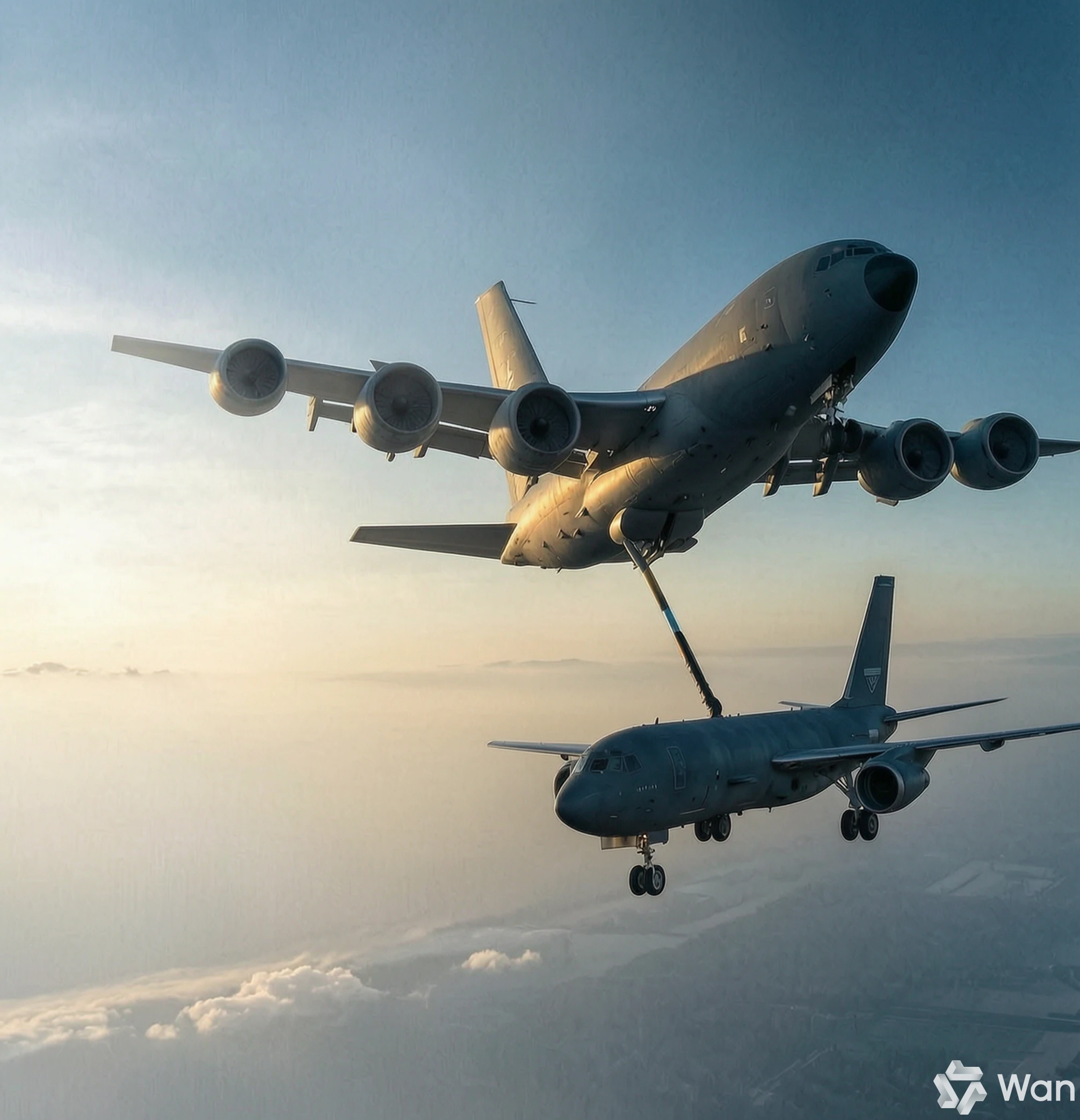
1The Traditional Giants: From the KC-135 to the KC-46A and A330 MRTT
Aerial refueling is one of the most critical support missions of modern air forces. By transferring fuel to fighter aircraft in flight, it extends mission range and time on station. This capability has run on the same basic principle for decades: two aircraft fly at high speed and in very close proximity while fuel is transferred between them.
The Turkish Air Force has operated seven KC-135R Stratotankers for roughly 30 years. These aircraft transfer fuel to fighter jets in flight, extending their mission range and time aloft. Traditional tankers like the KC-135 are quite large platforms; it has a maximum fuel offload capacity of about 90.7 tons and operates with a crew of four.
The newer generation is led by more modern tankers such as the KC-46A Pegasus and the A330 MRTT. The KC-46 carries roughly 96 tons of fuel, while the A330 MRTT carries around 111 tons. But this shift isn't only about carrying more fuel — the real change lies in how the mission itself is carried out.
2Automation Enters the Picture
Aerial refueling is a highly delicate operation. With two aircraft flying at high speed and in extremely close proximity, the fuel transfer must be carried out safely and precisely. As a result, the process itself is becoming increasingly automated on next-generation tankers.
Airbus has tested an automated aerial refueling system on the A330 MRTT. The system can track the receiver aircraft, automatically align the boom, complete the connection, and manage the fuel transfer process. The operator's role shifts from actively managing the process to monitoring it.
So what could the next stage look like? The U.S. Navy's MQ-25A Stingray program takes a different approach altogether.
3MQ-25 Stingray: A Different Approach
The MQ-25 is not a direct replacement for large strategic tankers. It's a smaller, unmanned tanker designed to operate from an aircraft carrier. The MQ-25's total fuel capacity has not been publicly disclosed, but the program's goal is to transfer roughly 6.3 to 7.3 tons of fuel at a distance of about 926 kilometers from the carrier.
This matters a great deal to the U.S. Navy. Today, some F/A-18 Super Hornets are pulled from their primary combat role and assigned to tanker duty to refuel other fighters. While flying a tanker mission, that aircraft cannot be used in its primary combat role.
The MQ-25 aims to hand this mission off to an unmanned platform. That would free Super Hornets to return to combat roles, while the refueling mission is carried out by an aircraft with no pilot in the cockpit.
4The Other Advantage of Going Unmanned
The advantage of an unmanned platform isn't limited to freeing up combat aircraft. Crew and aircrew training, flight hours, and human physiological limits are all significant factors in tanker operations. When the threat level rises, trained crew members are put at risk alongside the aircraft itself.
For this reason, it may be more accurate to view manned and unmanned tankers of the future not as direct competitors, but as complementary systems. Large tankers such as the KC-46A and A330 MRTT carry large volumes of fuel over long distances, while smaller unmanned tankers like the MQ-25 can deliver fuel to fighter aircraft at points much closer to the operational area.
5Synthesis: A Two-Stage Transformation
So the future of tanker aircraft isn't only about going unmanned. First, the refueling process itself becomes automated. Then, part of the tanker mission shifts to unmanned platforms. The MQ-25 Stingray is one of the most important examples of this transformation flying today.
| Platform | Type | Max Fuel Capacity | Crew | Defining Feature |
|---|---|---|---|---|
| KC-135R Stratotanker | Large Manned Tanker | ~90.7 tons | 4 crew | ~30 years in Turkish Air Force service |
| KC-46A Pegasus | Large Manned Tanker | ~96 tons | Manned crew | Next-generation capacity |
| A330 MRTT | Large Manned Tanker | ~111 tons | Manned crew | Automated aerial refueling testing |
| MQ-25A Stingray | Carrier-Based Unmanned Tanker | Not publicly disclosed | Unmanned | Goal: 6.3–7.3 tons at ~926 km |
The shift isn't only about carrying more fuel. The capacity gains from the KC-135 to the KC-46A and A330 MRTT matter, but the real transformation is in how the mission is executed.
Automation comes first, unmanning comes second. The A330 MRTT's automated boom alignment and connection system turns the operator's role from active management into monitoring.
The MQ-25 complements large tankers rather than replacing them. Big platforms move fuel over long distances, while small unmanned tankers bring it closer to the operational area.